“Real Estate Investment Strategies That Generate Passive Income in the U.S. (2026 Guide)”

Real Estate Investment Strategies That Generate Passive Income in the U.S. (2026 Guide)
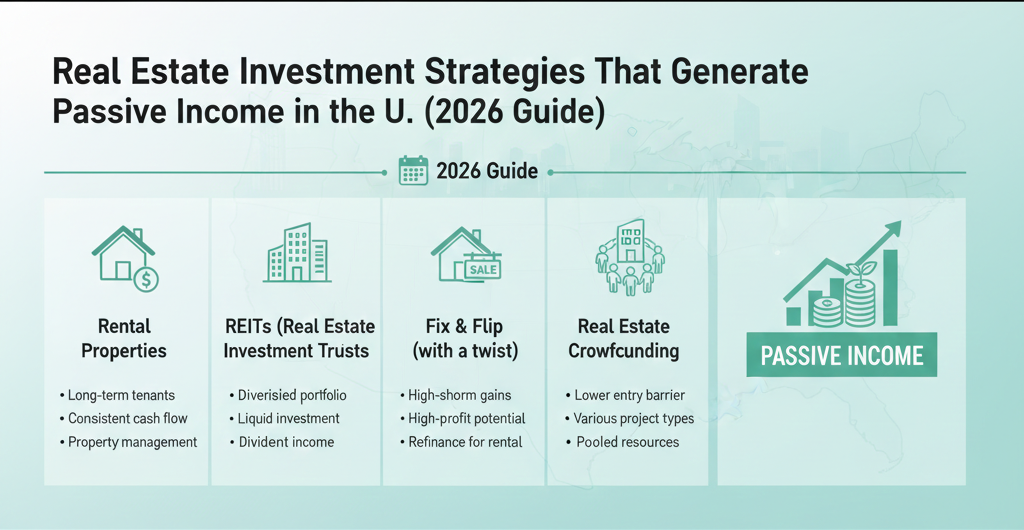





Real estate has long been considered one of the most reliable ways to build passive income, and in 2026, the U.S. market continues to offer strong opportunities for investors who know where to look. While rising interest rates, shifting work patterns, and changing demographics have reshaped the landscape, they have also created new income-generating strategies that were less common just a few years ago.
This guide explores practical, proven real estate investment strategies that can help you generate consistent passive income in the United States, whether you are a beginner or an experienced investor looking to optimize returns.
Why Real Estate Remains a Top Passive Income Asset
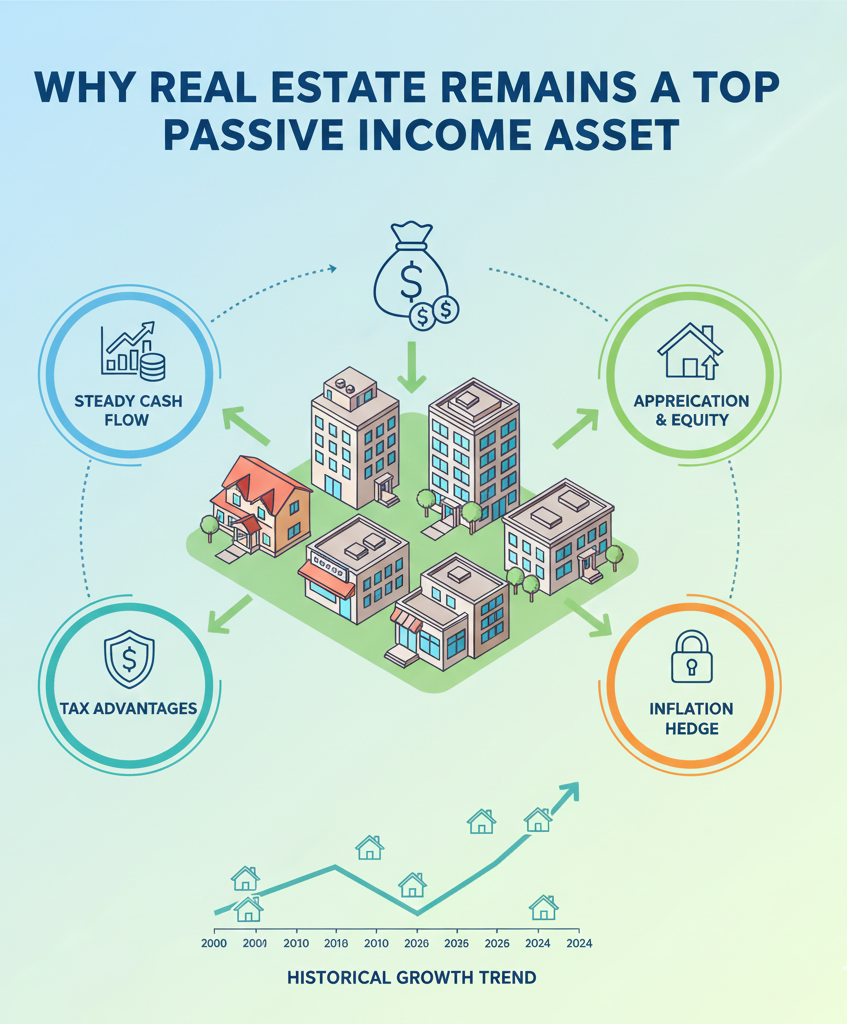
Unlike stocks or cryptocurrencies, real estate provides multiple income layers. Investors can earn from monthly cash flow, long-term appreciation, tax advantages, and inflation protection. In 2026, rental demand in many U.S. cities remains strong due to housing shortages, population migration, and affordability challenges for first-time homebuyers.
What makes real estate especially attractive is control. Investors can actively influence returns through renovation, better management, financing strategies, and smart market selection.
1. Long-Term Rental Properties
Long-term residential rentals remain one of the most stable passive income strategies in the U.S. This approach involves purchasing single-family homes or small multifamily properties and leasing them to tenants for extended periods, usually 12 months or more.
Why it works in 2026:
-
High rental demand in suburban and secondary markets
-
More Americans renting due to high home prices
-
Predictable monthly cash flow
To maximize passive income, successful investors focus on:
-
Buying in landlord-friendly states
-
Targeting areas with job growth and population inflow
-
Hiring professional property management to reduce hands-on work
While returns may not be explosive, long-term rentals offer consistency and lower risk, making them ideal for income-focused investors.
2. Short-Term Rentals (Airbnb & Vacation Rentals)
Short-term rentals continue to outperform traditional rentals in select markets. Cities with strong tourism, business travel, or seasonal demand can generate significantly higher monthly income.
However, regulation has become stricter in many states and cities. In 2026, successful short-term rental investors prioritize compliance, data-driven market research, and automation.
Best practices:
-
Invest in markets with clear short-term rental laws
-
Use dynamic pricing tools
-
Outsource cleaning and guest communication
When managed correctly, short-term rentals can deliver strong cash flow while still appreciating in value over time.
3. Multifamily Real Estate Investing
Multifamily properties, such as duplexes, triplexes, and apartment buildings, are a favorite among investors seeking scalable passive income.
The main advantage is efficiency. One property with multiple units spreads risk across several tenants while reducing per-unit operating costs.
In 2026, smaller multifamily properties (2–20 units) are especially attractive due to:
-
Easier financing compared to large apartment complexes
-
Strong demand for affordable rental housing
-
Higher income stability during economic slowdowns
Many investors partner with others or use property managers to maintain a passive role while benefiting from steady cash flow.
4. Commercial Real Estate for Passive Income
Commercial real estate includes office buildings, retail spaces, warehouses, and medical facilities. While this asset class was heavily disrupted in the past, it has evolved rather than disappeared.
Certain sectors now stand out:
-
Industrial and logistics properties
-
Medical and healthcare real estate
-
Essential retail with long-term tenants
Commercial leases often provide higher income and longer lease terms, shifting many expenses to tenants. This structure can significantly reduce day-to-day involvement for investors.
5. Real Estate Investment Trusts (REITs)
For investors who want truly hands-off passive income, REITs remain one of the simplest options. REITs allow individuals to invest in income-producing real estate without owning or managing physical property.
In 2026, REITs focused on:
-
Data centers
-
Healthcare facilities
-
Industrial warehouses
continue to attract attention. REITs are required to distribute most of their income as dividends, making them popular for income-oriented portfolios.
While REITs do not offer the same tax advantages as direct ownership, they provide liquidity, diversification, and consistent payouts.
6. House Hacking for Accelerated Cash Flow
House hacking involves living in one unit of a multifamily property while renting out the others. This strategy allows investors to significantly reduce or eliminate housing expenses while building equity and rental income.
In high-cost U.S. markets, house hacking remains one of the fastest ways to:
-
Enter real estate with limited capital
-
Learn property management firsthand
-
Transition into full passive investing later
Many investors use this approach as a stepping stone before scaling into larger portfolios.
7. Turnkey Real Estate Investments
Turnkey properties are fully renovated, tenant-occupied rentals sold to investors who want immediate cash flow. These properties are often managed by professional teams, making them attractive for busy professionals and international investors.
The key to success with turnkey investing is due diligence. Location quality, management reputation, and realistic cash flow projections matter more than cosmetic appeal.
8. Leveraging Tax Benefits to Boost Passive Income
One of the most overlooked aspects of passive income is tax efficiency. U.S. real estate offers powerful tax advantages, including:
-
Depreciation deductions
-
Mortgage interest write-offs
-
1031 exchanges to defer capital gains
In 2026, strategic tax planning can significantly increase net income without buying additional properties. Many high-income investors work with specialized tax advisors to optimize their real estate portfolios.
Choosing the Right Strategy for You
There is no universal “best” real estate investment strategy. The right approach depends on your:
-
Risk tolerance
-
Time availability
-
Capital
-
Income goals
Some investors prioritize stable monthly income, while others focus on long-term appreciation with growing cash flow. The most successful investors often combine multiple strategies to diversify income streams.
Final Thoughts

Real estate remains one of the most powerful tools for generating passive income in the U.S., even as the market evolves. In 2026, success is less about speculation and more about strategy, data, and execution. By choosing the right investment model and aligning it with your financial goals, you can build sustainable income that works for you over the long term.
With careful planning and the right support system, real estate can move from a side investment to a core wealth-building engine.