How Millionaires Build Wealth Through Long-Term Real Estate Investments

When people study how self-made millionaires build lasting wealth, real estate appears again and again as a core strategy. Not because it is fast or flashy, but because it rewards patience, discipline, and smart decision-making. Long-term real estate investing has quietly created more millionaires in the U.S. than almost any other asset class.






In 2026, this strategy remains just as relevant—if not more so. The difference between average investors and wealthy ones often comes down to time horizon, leverage, and consistency.
Why Millionaires Favor Long-Term Real Estate
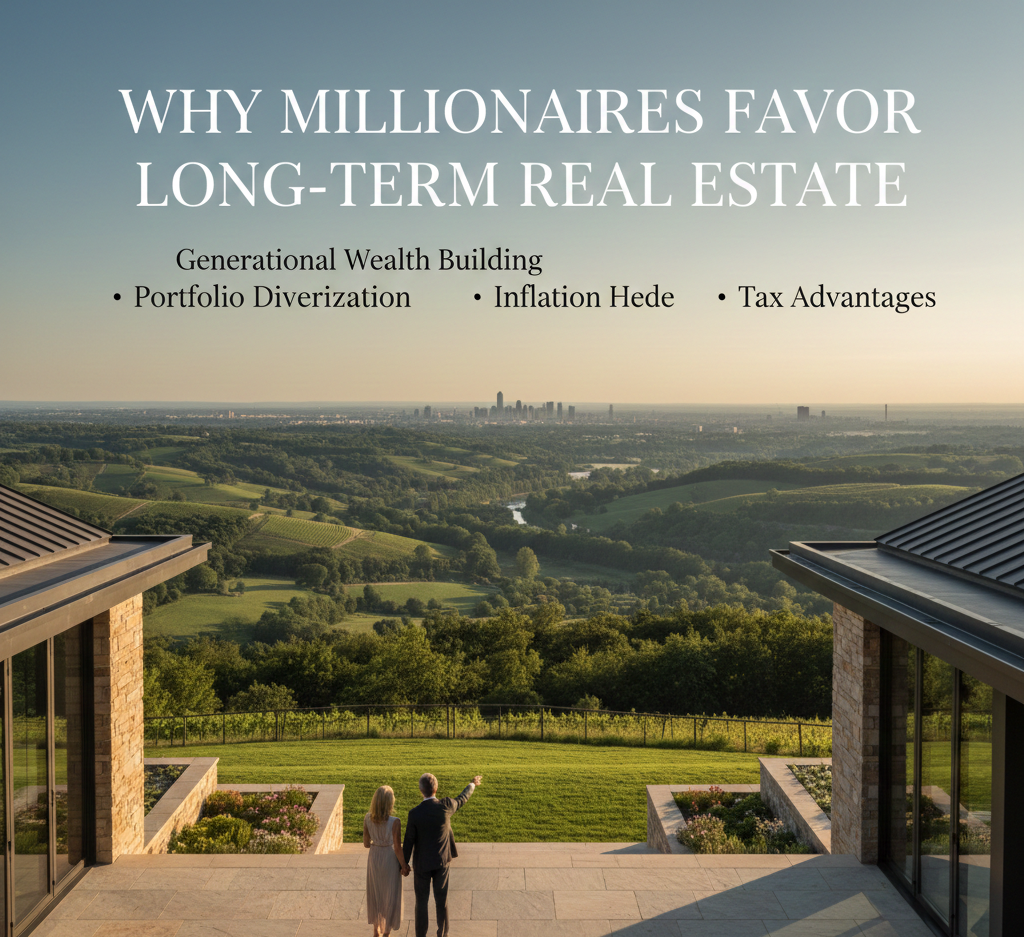
Millionaires rarely chase short-term market timing. Instead, they focus on assets that compound steadily over decades. Real estate fits this mindset perfectly because it offers:
-
Predictable cash flow
-
Long-term appreciation
-
Tax efficiency
-
Inflation protection
Rather than trying to guess market peaks and bottoms, wealthy investors buy quality assets and allow time to do the heavy lifting.
1. Buying for Cash Flow First, Appreciation Second
One of the biggest mistakes beginners make is relying solely on appreciation. Millionaires approach real estate differently. They prioritize cash-flow-positive properties from day one.
Rental income:
-
Covers mortgage payments
-
Pays operating expenses
-
Creates monthly surplus income
Over time, rents increase while fixed mortgage payments stay the same, naturally expanding profit margins. Appreciation becomes a bonus—not the foundation.
2. Using Leverage Strategically
Millionaires understand how to use good debt. Instead of avoiding loans, they use long-term, fixed-rate financing to control valuable assets with relatively small amounts of capital.
For example:
-
A 20–25% down payment controls 100% of the property
-
Tenants effectively pay down the loan
-
Equity grows every month
This controlled leverage accelerates wealth without excessive risk when used conservatively.
3. Holding Assets Through Market Cycles
Long-term investors do not panic during market downturns. In fact, many millionaires build wealth by buying during periods of uncertainty and holding through recovery cycles.
Historically, U.S. real estate has:
-
Recovered from every major downturn
-
Rewarded investors who held assets long enough
-
Penalized those who sold out of fear
Time in the market consistently outperforms trying to time the market.
4. Reinvesting Cash Flow and Equity
Wealthy investors rarely spend early profits. Instead, they reinvest rental income and extracted equity into new properties.
Common strategies include:
-
Refinancing to access built-up equity
-
Using 1031 exchanges to scale portfolios
-
Rolling profits into higher-performing assets
This compounding effect is a major reason long-term investors eventually control large property portfolios.
5. Leveraging Tax Advantages to Preserve Wealth
Taxes quietly erode wealth—but real estate offers powerful tools to reduce that erosion.
Millionaires benefit from:
-
Depreciation to reduce taxable income
-
Mortgage interest deductions
-
Capital gains deferral strategies
-
Pass-through income structures
Many high-net-worth investors legally pay less tax as their portfolios grow, increasing net returns without taking additional risk.
6. Focusing on Location and Demographics
Successful long-term investors think in decades, not quarters. They choose locations with:
-
Population growth
-
Job creation
-
Infrastructure investment
-
Strong rental demand
Rather than chasing trends, they focus on fundamentals that remain strong over time. This reduces volatility and supports steady appreciation.
7. Delegating Management to Stay Scalable
Millionaires value time more than control. As portfolios grow, they delegate property management, accounting, and maintenance to professionals.
This allows them to:
-
Scale without burnout
-
Maintain passive income
-
Focus on strategy rather than operations
Long-term wealth is built by systems, not constant hands-on work.
8. Avoiding Emotional Decision-Making
Emotion is the enemy of long-term investing. Wealthy investors rely on data, conservative projections, and clear exit strategies.
They avoid:
-
Overpaying in hot markets
-
Selling due to short-term fear
-
Speculative renovations without numbers
Discipline, not excitement, is what compounds wealth over time.
Why This Strategy Still Works in 2026

Despite changing interest rates and market conditions, the fundamentals remain the same:
-
People need housing
-
Inflation increases replacement costs
-
Rental demand stays strong
Long-term real estate investing is not about beating the market—it’s about owning durable assets that grow steadily while others wait on the sidelines.
Final Thoughts

Millionaires are not built overnight, and real estate wealth is rarely sudden. It is created through consistent action, patience, and long-term vision. By focusing on cash flow, smart leverage, tax efficiency, and time in the market, real estate investors quietly build wealth while others look for shortcuts.
In 2026 and beyond, long-term real estate investing remains one of the most reliable paths to financial independence—proven, repeatable, and scalable for those willing to commit for the long run.